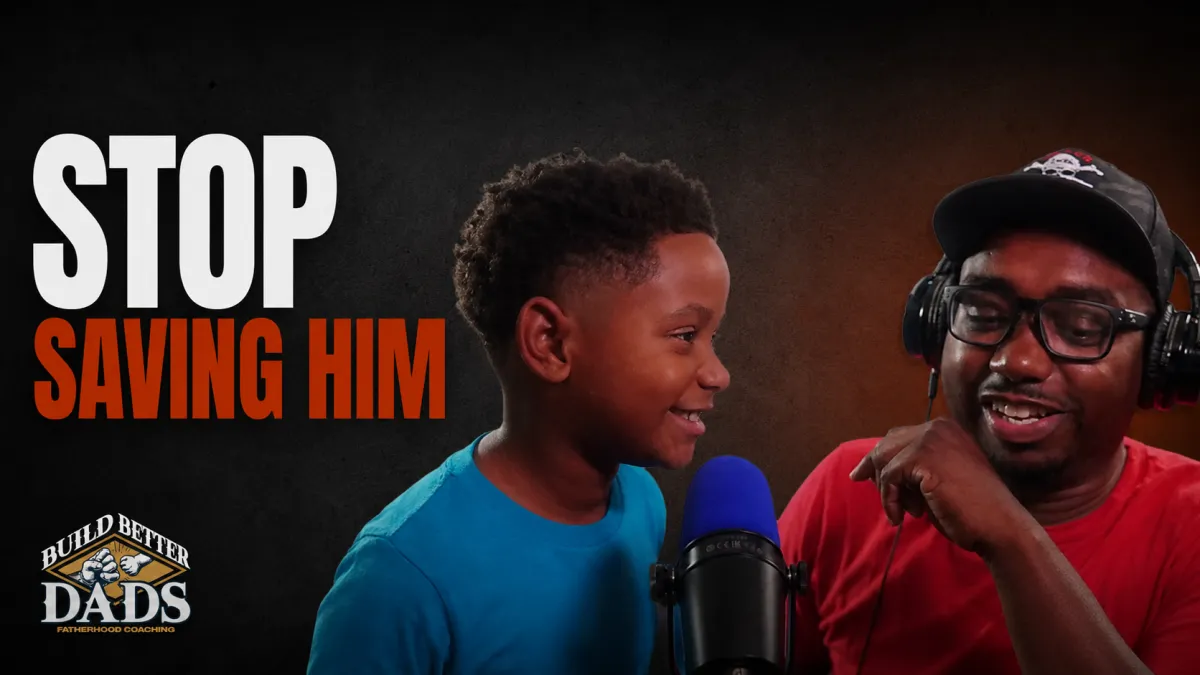
Stop Rescuing Your Son: Teach Responsibility Instead
Stop Rescuing Your Son: How to Teach Responsibility Without Abandoning Him
Every father wants to protect his son from unnecessary pain.
But sometimes protection quietly becomes prevention: preventing him from feeling disappointment, facing consequences, solving problems or discovering what he can handle.
We call the school after he forgets the assignment. We replace something he lost before he feels the cost. We wake him five times, finish the task, explain away the missed deadline or confront every person who frustrates him.
In the moment, rescuing feels like love. It lowers everybody’s stress and keeps the day moving.
But if I repeatedly remove every manageable consequence from my son Karter’s life, I may also remove the lesson that would prepare him for adulthood.
The answer is not to become cold or say, “Figure it out,” while he is drowning. A father should remain present. The change is in how we help.
Do not carry what your son is capable of learning to carry. Coach him while the weight is still manageable.
How can fathers support sons without enabling them?
Fathers can support sons without enabling them by teaching the missing skill, setting clear expectations, offering limited guidance and allowing safe, proportionate consequences. Support increases a son’s ability to solve the next problem. Enabling repeatedly solves the problem for him, excuses avoidable behavior or protects him from discomfort he is capable of managing.
Healthy support says, “I will help you think this through.”
Enabling says, “I will keep taking ownership so you never have to.”
Abandonment says, “Your needs and safety are not my concern.”
Those are three different choices.
Support, enabling and abandonment are not the same
ResponseWhat the father doesWhat the son learnsSupportTeaches, guides, sets limits and lets the son act“I can learn to handle this.”EnablingRepeatedly removes consequences or completes his responsibilities“Someone will handle it if I wait.”AbandonmentWithholds necessary care, safety, instruction or age-appropriate help“I am alone when I genuinely need support.”
The goal is not maximum discomfort. The goal is useful responsibility inside a safe relationship.
A son still needs food, shelter, medical care, emotional connection, protection from abuse and developmentally appropriate guidance. Allowing a forgotten lunch occasionally is not the same as withholding food. Letting him explain a missed assignment is not the same as ignoring a serious learning problem.
Responsibility without relationship can become harshness. Relationship without responsibility can become dependence. Fathers need both.
Why fathers rescue even when they know it is not helping
Rescuing is not always caused by a weak son. Sometimes it begins with a father’s discomfort.
We may rescue because:
His frustration makes us anxious.
We are embarrassed by how his mistake reflects on us.
Doing it ourselves is faster.
We fear that one consequence will ruin his future.
We feel guilty about working too much or past parenting mistakes.
Conflict exhausts us.
We mistake being needed for being close.
We do not trust him to struggle without falling apart.
We were treated harshly and overcorrect by removing every difficulty.
Before stepping in, ask:
“Am I solving this because he cannot handle it—or because I cannot tolerate watching him handle it imperfectly?”
That question is uncomfortable. It is also useful.
Use the COACH method instead of carrying the problem
C — Clarify what happened
Begin with facts, not a character attack.
Instead of:
“You are irresponsible.”
Try:
“The project was due today, and it was not submitted. Walk me through what happened.”
Listen for the actual breakdown:
Did he forget?
Did he misunderstand the instructions?
Did he avoid starting because he feared failure?
Did he underestimate the time?
Did he choose entertainment over the responsibility?
Does he lack the skill to organize the work?
Is something larger affecting his ability to function?
Consequences matter, but a consequence cannot teach a skill you have not identified.
O — Offer tools and limited options
Support should give your son something he can use—not take the job away from him.
You might offer:
A calendar or checklist
A demonstration of the first step
Two reasonable choices
Help breaking a task into smaller parts
A practice conversation
Transportation when appropriate
Access to a tutor, coach or professional
A quiet place and agreed work period
Say:
“I will help you plan the email. You will write and send it.”
Or:
“You can do the chores before practice or immediately afterward. Which one are you choosing?”
Options create ownership inside boundaries.
A — Agree on his next action
The son—not the father—should be able to state what happens next.
Ask:
“What are you going to do, and by what time?”
Make the action observable:
“I will email the teacher by 6:00 p.m.”
“I will put my uniform in the washer before dinner.”
“I will call the supervisor myself.”
“I will pay $20 from my savings toward the replacement.”
“I will try harder” is not a plan.
C — Consequences remain connected to the choice
A useful consequence is safe, proportionate, predictable and related where possible.
Examples:
If he spends money reserved for an activity, he may need to miss or delay the activity.
If he damages something carelessly, he contributes time or money toward repair.
If chores are required before gaming, gaming waits.
If he misses a deadline, he communicates with the affected person and accepts the result.
If he repeatedly wakes late, bedtime and device routines may need to change.
The American Academy of Pediatrics recommends calm, consistent consequences and emphasizes following through while avoiding deprivation of genuine needs. HealthyChildren.org discipline guidance
Do not secretly reverse the consequence because watching it feels uncomfortable. If the consequence is truly unsafe or disproportionate, change it openly and explain why.
H — Hand ownership back
End with confidence, not contempt.
“I love you. I am available if you need help thinking. This part belongs to you.”
Then stop hovering. Do not send six reminders after agreeing he will manage it. Ownership requires space.
Before allowing a consequence, use the SAFE test
Not every consequence should be allowed to unfold. Use four questions.
S — Is anyone’s safety at serious risk?
Intervene when there is meaningful risk of injury, abuse, exploitation, self-harm, violence, criminal conduct or another danger your son is not equipped to manage.
A — Is the expectation age- and ability-appropriate?
A ten-year-old, sixteen-year-old and twenty-four-year-old should not carry identical responsibilities. Consider maturity, disability, health, available instruction and the complexity of the task.
F — Is the consequence fair and proportionate?
One missed chore should not destroy the relationship or remove every privilege indefinitely. The consequence should teach, protect or repair—not satisfy a father’s anger.
E — Is there a real educational value?
Ask what the consequence can teach. If the answer is merely “He will know I am in charge,” reconsider the approach.
Manageable discomfort can build competence. Overwhelming or humiliating punishment can produce fear, secrecy or resentment instead.
Chores: move from helping to ownership
Chores are not simply a way to get free labor. They are practice in contribution, consistency and living with other people.
Give ownership, not occasional favors
“Help when I ask” keeps the father as the manager. Ownership gives the son a defined area:
Laundry on a specific day
Dishes after dinner
Trash and recycling
Keeping a bathroom clean
Preparing one family meal
Caring for a pet
Yard or household maintenance appropriate to age
Define what “done” means. A child may genuinely not understand your standard.
Instead of:
“Clean the kitchen.”
Clarify:
“Load the dishwasher, wipe the counters, sweep the floor and take out the trash.”
Teach once, supervise practice, then step back
Use a responsibility ladder:
I do it while you watch.
We do it together.
You do it while I check.
You do it and report completion.
You own it without reminders.
Do not demand step five before teaching steps one through four. But do not remain permanently at step two because your way is faster.
Connect privileges to contribution
A son is part of the household, not a hotel guest. Recreation can follow responsibilities without making love, food or belonging conditional.
Say:
“You do not earn your place in this family. You do earn optional privileges by handling agreed responsibilities.”
Missed deadlines: stop becoming his emergency department
A forgotten deadline can become a powerful lesson when the stakes are manageable.
If he forgets a school project, resist writing the teacher yourself immediately.
Ask:
“What is the consequence?”
“Who needs to hear from you?”
“What will you say without making excuses?”
“What system will prevent this next time?”
You can review the email without sending it for him:
“I missed the deadline. That was my responsibility. Is late submission possible? I understand if there is a penalty. Here is the system I am using next time.”
One missed assignment usually teaches more than a father repeatedly managing the entire school relationship. But a pattern of missed work deserves investigation—not endless punishment.
The CDC describes parent engagement with schools as a shared effort that supports learning and development. Fathers can remain engaged without completing the student’s responsibility. CDC parent engagement guidance
Problem-solving: ask before you answer
When your son brings a problem, avoid treating speed as the goal.
Try this sequence:
“What happened?”
“What have you already tried?”
“What options do you see?”
“What might happen with each option?”
“Which option are you choosing?”
“What support do you need from me?”
If he says, “I don’t know,” do not rush to fill the silence. Offer a limit:
“Give me two possible options, even if neither is perfect.”
Executive-function skills—such as planning, focusing attention, managing information and making decisions—develop through practice and supportive environments. They are not abilities children are simply born knowing how to use. Harvard Center on the Developing Child
Fathers should create practice, not expect instant mastery.
Work ethic: teach the process, not only the result
Work ethic is more than working long hours. It includes:
Starting without perfect motivation
Doing unglamorous tasks well
Arriving prepared and on time
Communicating when a commitment cannot be met
Accepting feedback without collapsing or attacking
Completing the final ten percent
Resting responsibly instead of avoiding indefinitely
Learning skills that increase future value
Give praise that identifies behavior:
“You kept going after the first attempt failed.”
“You communicated before the deadline instead of disappearing.”
“You noticed the mistake and repaired it without being chased.”
That teaches him what to repeat.
Avoid praising only talent: “You are naturally smart.” A son who builds identity around appearing naturally gifted may avoid difficult work that exposes struggle.
Money: do not erase every financial mistake
Small financial consequences can teach while the numbers are small.
If your son spends all his money, do not automatically fund the next optional purchase. If he loses something through carelessness, he may contribute toward replacement. If he wants an expensive item, help him create an earning and savings plan.
Ask:
“What did this decision cost beyond the money?”
“What will you do differently with the next amount?”
“How much should go to spending, saving and giving?”
“What can you earn rather than request?”
Do not use money to shame him. Use it to teach choices, delayed gratification and repair.
Allow manageable discomfort
Discomfort is not automatically harm.
Manageable discomfort may include:
Explaining his own mistake
Being bored without immediate entertainment
Waiting to afford something
Repeating a task done carelessly
Practicing after failure
Hearing constructive criticism
Losing a privilege connected to a choice
Feeling nervous before a responsible conversation
Being temporarily disappointed
Do not rush to erase these feelings. Say:
“I know this is uncomfortable. I also believe you can handle it.”
The CDC notes that seeking independence is a normal part of adolescence while the parent-child relationship remains important. CDC guidance for adapting to the teen years
Independence grows when a father gradually transfers real responsibility while remaining connected.
What fathers should not allow in the name of “natural consequences”
“Let him learn” is not a justification for neglect.
Do not stand aside when consequences involve:
Serious physical danger
Abuse, coercion or exploitation
Suicidal behavior or self-harm
Driving while impaired or other immediate danger
Untreated health needs
Hunger, unsafe housing or deprivation of basic care
Legal risks beyond his developmental capacity
Bullying or violence requiring adult intervention
A disability or condition requiring accommodation
Natural consequences are not a parenting religion. Judgment comes first.
If there is immediate danger, intervene. Teaching can happen after safety is restored.
Repeated failure may mean a missing skill—not a bad attitude
When your son continues failing at the same responsibility, consider several possibilities:
The expectation is unclear.
The task is too large and needs steps.
He has not practiced the skill.
The consequence is inconsistent.
Sleep, stress or another health issue is affecting him.
Anxiety, depression or fear of failure is driving avoidance.
Attention, learning or executive-function difficulties may be involved.
Family routines are chaotic or unpredictable.
He has learned that waiting long enough brings rescue.
He is choosing not to do it.
These possibilities require different responses.
A checklist may help forgetfulness. Practice may help lack of skill. A firm consequence may address a deliberate choice. Persistent difficulty across school, home and daily functioning may justify consultation with a pediatrician, school professional or qualified mental-health provider.
Do not diagnose laziness when you have not investigated the pattern.
At the same time, a diagnosis or difficulty does not mean responsibility disappears. It means support and expectations may need to be adapted so the son can build ownership realistically.
What to say instead of rescuing
When he forgot something
“What is your plan for handling the consequence and remembering next time?”
When he asks you to contact the teacher or coach
“You make the first contact. I will help you prepare, and I will step in if an adult issue remains unresolved.”
When he wants money after spending his
“I understand why you want it. I am not replacing the money you chose to spend. Let’s talk about how you can earn or save for it.”
When he procrastinated
“I will help you break the work into steps. I will not do the steps for you.”
When he is uncomfortable
“Do you need support—or do you need rescue from a feeling you can survive?”
When he blames someone else
“They may have contributed. What part still belongs to you?”
When he fails
“This result is information. What will you change before the next attempt?”
When he genuinely needs help
“You are not alone. Tell me which part you cannot safely handle, and we will work through it together.”
A responsibility agreement fathers can use
For recurring problems, write a short agreement with five parts:
Responsibility: What exactly belongs to the son?
Standard: What does successful completion look like?
Deadline: When must it be done?
Support: What instruction, tool or reminder will the father provide?
Consequence: What predictable result follows completion or noncompletion?
Example:
Responsibility: Complete and submit weekly assignments.
Standard: Check the school portal every weekday and record due dates.
Deadline: Review the list by 7:00 p.m.
Support: Dad helps set up the system and reviews it Sunday evening for four weeks.
Consequence: Optional gaming begins after the daily assignment check and required work.
Review the agreement after a set period. The goal is to reduce supervision as competence increases.
Frequently asked questions
What is the difference between supporting and enabling a son?
Support teaches skills, provides appropriate resources, maintains safety and leaves the son responsible for action. Enabling repeatedly excuses avoidable behavior, completes his responsibilities or removes consequences he is capable of handling.
Should parents let children experience natural consequences?
Yes, when the consequence is safe, age-appropriate, proportionate and likely to teach something useful. Parents should intervene when there is serious danger, abuse, unmet basic needs or consequences beyond the child’s developmental capacity.
How do I stop doing everything for my teenage son?
Choose one responsibility, define the standard, teach the process, agree on limited support and step back gradually. Avoid transferring every responsibility at once. Consistency matters more than a dramatic announcement.
What chores should a teenage son be responsible for?
Teenagers can usually contribute through laundry, dishes, cleaning shared spaces, meal preparation, pet care, yard work and basic household maintenance, adjusted for ability and family circumstances. The key is consistent ownership rather than occasional help.
Should I remind my son about responsibilities?
Reminders can be part of teaching, especially when a system is new. However, repeated personal reminders can keep the parent responsible. Transition toward calendars, alarms, checklists and agreed check-ins that the son learns to manage.
What if my son does not care about consequences?
Confirm that the consequence is consistent, proportionate and connected to something meaningful. Investigate whether the problem is missing skill, unclear expectations, emotional difficulty or deliberate refusal. Avoid simply making punishments larger without understanding the pattern.
Is allowing discomfort the same as tough love?
It can overlap, but the important standard is whether the approach is safe, connected and educational. Manageable discomfort can build competence. Humiliation, intimidation, neglect and deprivation of genuine needs do not teach healthy responsibility.
When should a father step in and solve the problem?
Step in when immediate safety, abuse, health, legal protection or developmental limitations require adult action. Even then, involve your son in the parts he can understand and manage so the experience still builds capacity.
Do not rescue him from becoming capable
Your son will eventually live in a world where missed deadlines matter, money runs out, supervisors expect communication, roommates expect contribution and choices produce consequences.
If the first real consequence arrives after he leaves your home, it may be much more expensive than the lessons available now.
Do not abandon him to figure out life alone.
Stand close enough to coach. Far enough to let him act. Calm enough to let a safe consequence teach. Honest enough to recognize when the rescue is relieving your anxiety more than building his ability.
Tell him:
“I will always be your father. I will help you learn. But I will not keep taking responsibilities that belong to the man you are becoming.”
For the larger father-son framework, read 7 Conversations Every Father Should Have With His Son Before 18.
Use 25 Questions Every Father Should Ask His Son Before 18 to continue conversations about independence and responsibility once that companion article is published.
Subscribe to the Build Better Dads YouTube channel for practical conversations about fatherhood, financial resilience, relationships and preparing children for the real world.
Help your son develop resilience, responsibility and character with The UnBreakable Son Ebook.