
18 Skills Your Son Needs Before Moving Out
How Do I Know if My Son Is Ready for the Real World? 18 Skills to Check Before He Leaves Home
One day, Karter will leave my house and begin making decisions without me standing beside him.
I do not want that day to be the first time he reads a lease, makes a doctor’s appointment, plans meals, handles a disagreement, understands a paycheck or admits that he needs help.
Our job as fathers is not simply to keep our sons alive until age 18. It is to prepare them to manage real responsibilities after our daily supervision ends.
A birthday does not automatically make a son ready. Neither does confidence, a diploma, a paycheck or the ability to drive.
Readiness is demonstrated through action.
What should a son know how to do before moving out?
Before moving out, a son should be able to communicate clearly, regulate emotions, resolve ordinary conflict, make decisions, manage time, ask for help, care for his health, use technology safely, cook, clean, handle basic home problems, respond to emergencies, maintain employment, budget, use banking and credit responsibly, understand housing obligations, manage transportation and protect essential documents. He does not need to know everything, but he should know how to learn what he does not know.
The question is not, “Can he do every task perfectly?”
The better question is:
“Can he recognize a problem, take responsible action and ask for appropriate help before the problem becomes a crisis?”
Readiness is evidence—not age
The CDC describes parenting as a process that prepares a child for independence. That process should happen gradually.
Do not wait until the month before your son moves out and attempt to teach adulthood in a weekend.
For every skill in this assessment, use three levels:
Not yet demonstrated: He has not performed the skill or cannot complete it safely.
Can do with guidance: He can participate but still needs reminders, instruction or direct help.
Can do independently: He has completed the skill responsibly more than once without being rescued.
Do not rate him based on what he promises he could do. Watch what he actually does.
1. Can he communicate clearly and listen?
Your son should be able to:
introduce himself;
explain a problem without becoming disrespectful;
listen long enough to understand another person;
ask useful follow-up questions;
make a phone call to an unfamiliar adult;
write a clear email or message;
speak to a teacher, supervisor, landlord or service provider;
confirm important details in writing.
Test the skill
Ask him to call a business, schedule a service or email a teacher about a real issue. Let him prepare first, but do not speak for him.
Father’s coaching question
“What does this person need to know, and what outcome are you asking for?”
2. Can he handle conflict, boundaries and repair?
Living independently means dealing with roommates, coworkers, neighbors, friends and partners who will not always agree with him.
He should be able to:
disagree without threatening or insulting;
state a boundary clearly;
hear “no” without retaliation;
walk away before anger becomes aggression;
recognize when he caused harm;
apologize without adding an excuse;
negotiate ordinary shared responsibilities;
seek mediation or authority when a situation cannot be resolved safely.
Test the skill
Give him responsibility for resolving a manageable household disagreement. Observe whether he listens, explains and follows through.
Father’s coaching question
“Are you trying to solve the problem—or prove that you are the winner?”
3. Can he regulate anger, fear, disappointment and pressure?
Emotional regulation does not mean never feeling angry, afraid or overwhelmed. It means recognizing an emotion and choosing what to do with it.
He should be able to:
name what he is feeling;
pause before an impulsive action;
use healthy ways to calm his body;
express distress without violence or destruction;
tolerate disappointment;
return to a problem after calming down;
recognize when he needs professional support.
The CDC’s guidance for coaching teen emotions emphasizes listening, empathy and open-ended questions rather than immediately forcing advice.
Test the skill
Pay attention after a disappointing grade, loss or rejection. Does he recover, reflect and take the next action—or blame, disappear or explode?
Father’s coaching question
“What are you feeling, what is that feeling pushing you to do and what response will help instead of hurt?”
4. Can he ask for help—and know when a problem is urgent?
Independence is not doing everything alone. It is knowing what you can handle and when to involve somebody qualified.
Your son should know how to contact:
a trusted family member;
emergency services;
a healthcare provider;
a teacher, school adviser or supervisor;
roadside assistance;
a bank’s fraud department;
a mental-health or crisis resource;
the appropriate local authority.
He should be able to say:
“I made a mistake. Here is what happened. Here is what I have done. I need help with this part.”
Test the skill
Give him three scenarios—a minor car problem, a suspicious banking transaction and a friend talking about self-harm. Ask whom he would contact and what he would say.
Father’s coaching question
“What could happen if you wait, and who is qualified to help?”
5. Can he make decisions and accept consequences?
Your son does not need to make the same decision you would make. He needs a reliable method.
Teach him to ask:
What problem am I solving?
What facts do I know?
What am I assuming?
What are my realistic options?
What could each choice cost—in money, time, safety, trust and opportunity?
Who has experience I should consult?
Can I reverse this decision?
What will I do if the plan fails?
Test the skill
Let him plan a meaningful purchase or family activity with a fixed budget and deadline. Do not correct every small choice. Review the result afterward.
Father’s coaching question
“Which consequence are you willing to own?”
6. Can he manage time, appointments and administrative tasks?
Many young adults do not fail because they lack intelligence. They miss deadlines, forget renewals and avoid uncomfortable calls.
Your son should be able to:
use a calendar;
arrive on time;
plan backward from a deadline;
set reminders;
complete forms accurately;
keep confirmation numbers;
read official messages;
follow up when no response arrives;
cancel or reschedule an appointment responsibly.
Test the skill
Put him in charge of scheduling one real appointment, adding it to his calendar, preparing what he needs and arriving on time.
Father’s coaching question
“What needs to happen before the deadline—not on the deadline?”
7. Can he manage his basic healthcare?
Before leaving home, he should know:
his important medical history;
allergies;
medications and correct use;
how to schedule an appointment;
how to refill a prescription;
how insurance or payment works at a basic level;
where to seek routine, urgent and emergency care;
how to describe symptoms honestly;
how to protect private health information.
The American Academy of Pediatrics encourages young people to develop a voice in their care and practice tasks such as making appointments and filling prescriptions. This transition should begin before adulthood, not after the parent is no longer available.
Test the skill
Have him lead the administrative part of his next routine appointment while you remain available if needed.
Father’s coaching question
“If I were unavailable, what information would the doctor need from you?”
8. Can he use phones, social media and online services safely?
He should be able to:
protect passwords and verification codes;
recognize common scam tactics;
avoid oversharing his location and private information;
verify identities and unusual requests;
manage screen habits without sacrificing sleep or responsibilities;
understand that digital material can be copied;
respond safely to threats, blackmail and sexual requests;
question misleading or AI-generated content;
ask for help before paying or complying with a threat.
Test the skill
Show him sample phishing messages, fake job offers and urgent payment requests. Ask him to identify the warning signs and verification steps.
Father’s coaching question
“What is this message trying to make you do before you have time to think?”
9. Can he plan, shop for and cook basic meals?
He does not need to become a chef. He should be able to feed himself safely without depending entirely on restaurants, delivery or another person.
He should know how to:
plan several affordable meals;
make a grocery list;
compare unit prices;
store food safely;
avoid cross-contamination;
use basic kitchen equipment;
follow a recipe;
prepare at least five balanced meals;
clean the kitchen afterward;
use leftovers before they spoil.
Test the skill
Give him a fixed food budget and responsibility for planning, buying, preparing and cleaning up after two family dinners.
Father’s coaching question
“How will you eat well on Wednesday—not only when you feel motivated on Sunday?”
10. Can he manage laundry, cleaning and personal hygiene?
Household care is not women’s work or somebody else’s work. It is adult work.
He should know how to:
sort and wash clothing;
read care labels;
change bedding;
clean a bathroom;
wash dishes;
sweep, mop and vacuum;
manage trash and recycling;
prevent pests and odors;
maintain personal hygiene;
create a repeatable cleaning schedule.
Test the skill
Give him full responsibility for his laundry, bedroom and one shared household space for a month—without repeated reminders.
Father’s coaching question
“What system will keep this handled when nobody reminds you?”
11. Can he handle basic home problems and utilities?
He should know how to:
reset a circuit breaker safely;
locate water and power shutoffs where appropriate;
use a plunger;
change a light bulb and common batteries;
recognize a gas smell, leak or electrical danger;
test smoke and carbon-monoxide alarms;
report maintenance problems promptly;
read basic utility information;
know which repairs require a professional.
Do not encourage unsafe do-it-yourself work. Maturity includes knowing when not to touch something.
Test the skill
Walk through the home and ask him to identify alarms, shutoffs, emergency exits and the information he would give a landlord or technician.
Father’s coaching question
“Is this safe for you to fix—or is your responsibility to stop the damage and call the right person?”
12. Can he respond to emergencies and protect himself?
Your son should know:
how and when to call emergency services;
his address and accurate location;
basic first aid;
what to do during a fire;
how to use a fire extinguisher if trained and safe;
how to respond to severe weather common in his area;
where emergency supplies are kept;
how to leave an unsafe situation;
not to drive impaired or ride with an impaired driver;
basic situational awareness.
Ready.gov’s safety guidance recommends learning skills such as first aid, CPR, fire-extinguisher use and utility shutoff. Training is better than assumptions.
Test the skill
Practice a fire exit, locate the first-aid kit and have him explain what he would do if a friend became unresponsive.
Father’s coaching question
“What is the safest first action, and who needs to be called?”
13. Can he obtain and maintain employment?
Work readiness is more than getting hired.
He should be able to:
create an accurate résumé or application;
search for legitimate opportunities;
recognize job scams;
prepare for an interview;
communicate availability;
arrive reliably;
follow instructions and ask clarifying questions;
receive feedback;
solve ordinary workplace problems;
understand that quitting has financial consequences;
leave a job professionally when possible.
Test the skill
Have him complete a real or realistic application, conduct a practice interview and draft a professional follow-up message.
Father’s coaching question
“What value are you responsible for delivering—and how will people know they can rely on you?”
14. Can he build and follow a monthly budget?
Before moving out, he should understand the difference between gross pay, take-home pay, fixed bills, variable expenses, savings and debt.
He should be able to:
total his monthly income;
list essential expenses;
estimate irregular costs;
make spending limits;
track actual spending;
save for emergencies;
plan for annual expenses;
adjust when expenses exceed income;
distinguish needs, obligations and wants.
Consumer.gov defines a budget as a monthly plan showing income and spending. A budget only becomes useful when it is reviewed against actual behavior.
Test the skill
Give him a realistic take-home income and local housing costs. Ask him to build a complete monthly plan, including food, transportation, utilities, insurance, savings and unexpected expenses.
Father’s coaching question
“What will you change when the numbers do not agree with the lifestyle you want?”
15. Can he use banking, credit and financial services responsibly?
He should know how to:
open and monitor a legitimate bank or credit-union account;
read a transaction history;
use a debit card safely;
recognize overdraft and account fees;
deposit money;
protect account credentials;
examine a pay stub;
understand credit reports and interest at a basic level;
compare the real cost of borrowing;
report fraud quickly;
avoid payday loans and suspicious money transfers.
Test the skill
Review a sample pay stub, bank statement and credit-card offer. Ask him to explain the fees, interest and warning signs in his own words.
Father’s coaching question
“What is the total cost—not only the monthly payment?”
16. Can he evaluate housing and live responsibly with others?
Before signing anything, he should understand:
rent and security deposits;
lease length;
utilities;
renter’s insurance;
move-in condition documentation;
maintenance reporting;
roommate expectations;
guest and noise rules;
late fees and eviction consequences;
scams involving deposits or fake listings;
what he can realistically afford.
He should also be prepared to share space: pay on time, clean common areas, respect privacy, communicate about guests and address conflict early.
Test the skill
Give him a sample rental listing and lease. Ask him to calculate the full move-in cost, recurring cost and questions he should ask before paying anything.
Father’s coaching question
“What responsibility are you accepting when you sign your name?”
17. Can he manage transportation and navigate independently?
Whether he drives, uses transit, walks or rides a bicycle, he should be able to:
plan a route and backup route;
arrive on time;
budget transportation costs;
respond to a delay or breakdown;
use navigation without ignoring surroundings;
maintain a vehicle if he owns one;
understand basic insurance and registration requirements;
arrange safe transportation instead of driving impaired;
identify who to call in an emergency.
Test the skill
Ask him to plan and complete a trip to an unfamiliar but safe location, including cost, timing and a backup plan.
Father’s coaching question
“What will you do if the original plan fails halfway there?”
18. Can he protect documents and handle adult records?
He should know what important records exist, why they matter and how to protect them.
Depending on his country and situation, these may include:
birth certificate;
government identification;
tax or national identification number;
passport;
health and insurance information;
education and employment records;
lease and banking documents;
vehicle records;
emergency contacts.
He should know which documents should not be carried daily, photographed casually, emailed insecurely or shared with an unverified person.
Test the skill
Have him create a secure inventory showing what documents he has, where originals are stored, which copies are needed and how to replace a missing record.
Father’s coaching question
“What could someone do with this information if you gave it to the wrong person?”
The 18-skill real-world readiness scorecard
Score observed performance—not promises.
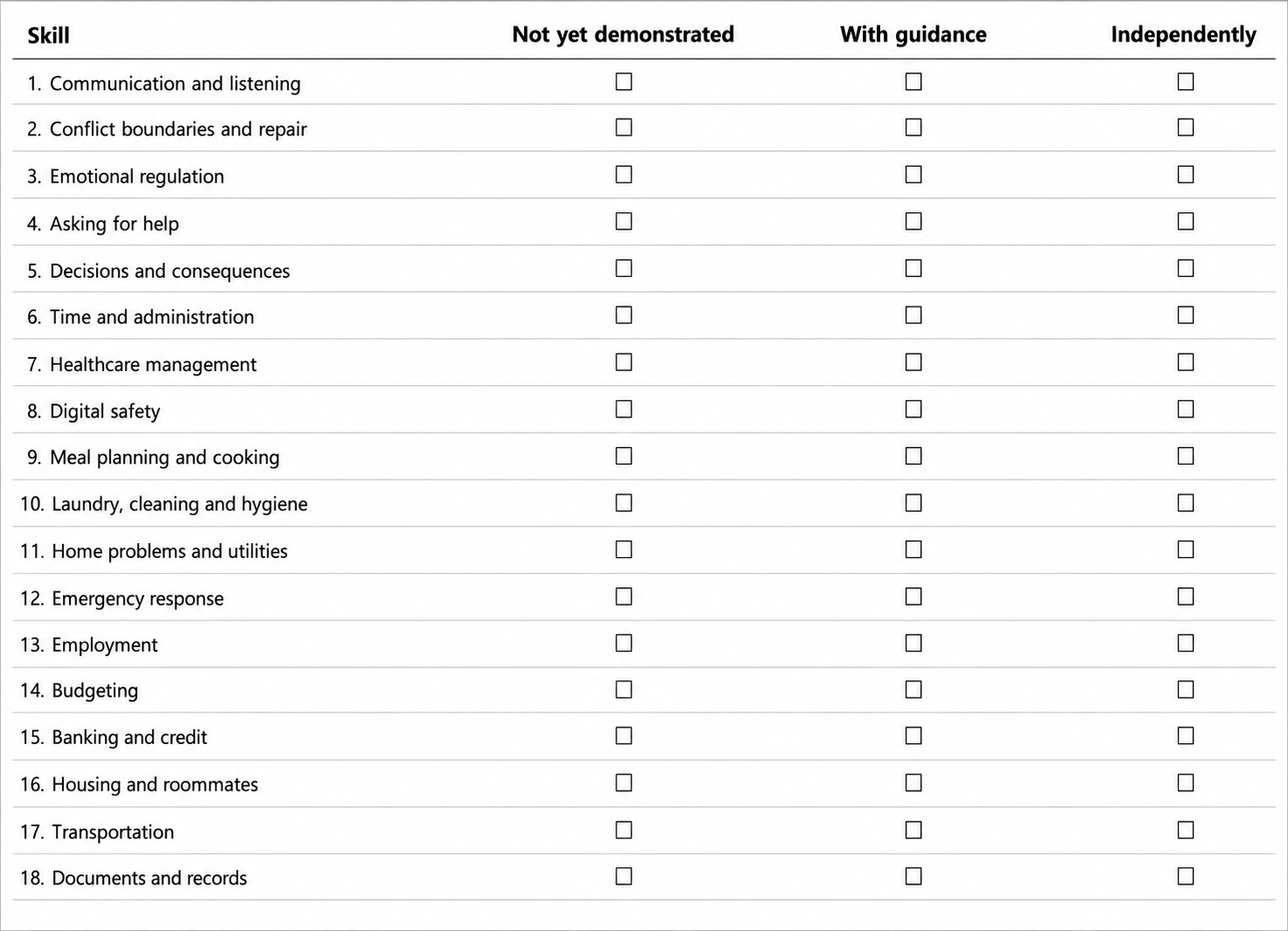
You may assign 0 points for “not yet demonstrated,” 1 for “with guidance” and 2 for “independently.” The highest possible total is 36.
29–36: He demonstrates substantial readiness, but address every safety-critical gap and every zero.
20–28: He has a foundation but still needs planned practice before full independence.
0–19: He needs more guided responsibility and real-world repetitions before moving out without substantial support.
The total is not a diagnosis or guarantee. One serious gap—such as emergency judgment, inability to seek help or unsafe money behavior—can matter more than a high total.
Readiness also looks different for sons with disabilities, chronic health conditions or different developmental needs. The goal is the greatest safe independence possible with appropriate supports—not comparison with somebody else’s son.
Build a 90-day readiness plan
Do not attack all 18 skills at once.
Days 1–7: Assess honestly
Complete the scorecard separately.
Compare your ratings.
Ask your son where he feels least prepared.
Choose three priority skills: one safety skill, one household skill and one money/work skill.
Days 8–30: Demonstrate and practice together
Show the task once.
Complete it together.
Let him lead while you observe.
Give specific feedback.
Days 31–60: Transfer responsibility
Give him ownership of real recurring tasks.
Reduce reminders.
Allow manageable consequences.
Hold a short weekly review.
Days 61–90: Test independence
Let him complete each task without intervention.
Introduce a realistic complication.
Review what happened.
Record the system he will use when he lives elsewhere.
Use this planning table:
Priority skillReal task he will ownSupport allowedEvidence of independenceReview date
Stop doing for him what he is capable of practicing
Fathers sometimes mistake service for preparation.
We schedule every appointment, wake him for every obligation, replace every lost item, complete every form and solve every conflict—then become frustrated that he does not act independently.
Ask yourself:
“Does he lack the ability—or has he never been given ownership?”
Teach first. Practice together. Transfer the task. Review the outcome.
Do not abandon him. Do not rescue him from every manageable inconvenience either.
Frequently asked questions
At what age should fathers begin teaching independent-living skills?
Begin in childhood with age-appropriate responsibilities and increase ownership gradually. A young child can organize belongings and help prepare food; a teenager can schedule appointments, manage a budget and communicate with adults. Waiting until age 18 creates unnecessary pressure.
Does turning 18 mean my son is ready to move out?
No. Legal adulthood and practical readiness are different. Evaluate demonstrated skills, income stability, housing, safety, judgment, support needs and the reason for moving. Some sons need more preparation or structured support, while others may demonstrate readiness earlier.
Should an adult son pay rent while living at home?
Rent can teach responsibility when it is part of a clear independence plan. The arrangement should define the amount, household expectations, savings goals, timeline and skills he is expected to develop. Collecting money without transferring responsibility does not automatically prepare him to live independently.
What are the most important skills before a son moves out?
Safety, help-seeking, emotional regulation, budgeting, reliable work habits, basic food and household care, healthcare management and sound decision-making are foundational. A weakness can be trained; dangerous secrecy and refusal to accept responsibility require particular attention.
What if my son refuses to learn life skills?
Make expectations and consequences clear, connect privileges to responsibility and stop automatically completing tasks he can perform. Ask what is behind the resistance: lack of skill, fear, embarrassment, executive-function difficulty, depression or simple avoidance may require different responses.
How much money should a son save before moving out?
There is no universal amount. He should calculate deposits, moving costs, essential furniture, transportation, insurance, utilities and a realistic emergency reserve based on his location and obligations. The important test is whether his actual income supports his full budget without depending on debt for ordinary bills.
What if my son has a disability or chronic health condition?
Plan for the greatest safe independence appropriate to his needs. Include healthcare professionals, school transition staff and support agencies when relevant. Adapt tasks, technology, transportation, housing and decision supports without assuming that independence must look identical for every young adult.
How can I test readiness without forcing my son to move out?
Give him adult responsibilities while he still lives at home: a monthly budget, meal planning, laundry, appointments, transportation, household contributions and problem-solving. Use real deadlines and natural consequences, then review his performance without taking the task back immediately.
The real world should not be his first classroom
Our sons do not need fathers who know everything.
They need fathers willing to show them, practice with them and gradually step back.
Before your son leaves home, give him more than advice. Give him repetitions.
Let him make the phone call. Let him cook the meal. Let him read the agreement. Let him solve the problem. Let him recover from the mistake.
Then let him know that independence does not cancel the relationship.
He can leave your house prepared—and still know where to turn when life becomes heavier than expected.
Continue the conversation
Begin with the cornerstone guide: 7 Conversations Every Father Should Have With His Son Before 18.
Read: Should Your Adult Child Pay Rent to Live at Home?(confirm the published URL before adding it).
Connect the communication section to How to Talk to a Teenage Son Who Doesn’t Want to Talk.(Add its published URL.)
Connect emotional regulation to How Fathers Can Teach Sons to Handle Anger, Fear and Pressure Without Shutting Down.(Add its published URL.)
Connect responsibility to Stop Rescuing Your Son: How to Teach Responsibility Without Abandoning Him.(Add its published URL.)
Connect failure recovery to How to Help Your Son Recover From Failure Without Fixing Everything for Him.(Add its published URL.)
Connect digital safety to What Every Father Should Teach His Son About Phones, Social Media and Online Pressure.(Add its published URL.)
Watch practical fatherhood conversations on the Build Better Dads YouTube channel.
Help your son build resilience, responsibility and character with The UnBreakable Son Ebook.