25 Questions Every Father Should Ask His Son Before 18
What Should a Father Talk About With His Son? 25 Questions to Ask Before 18
My son Karter will not be a child forever.
One day, he will leave my house and make decisions without me standing beside him. I cannot prepare him for that day with rules alone. Rules may control what a boy does while I am watching. Conversations help shape the man he becomes when I am not there.
That is why I believe fathers must do more than tell their sons what to do. We have to ask questions that help them think, speak honestly and understand themselves.
You do not need a perfect speech. You do not need to ask all 25 questions in one sitting. Choose one question, create a safe moment and listen carefully to the answer.
What should a father talk about with his son?
A father should talk with his son about identity, character, friendships, peer pressure, emotions, money, relationships, responsibility, failure and his plans for adulthood. The best conversations use open-ended questions that cannot be answered with only “yes,” “no” or “fine.” A father’s first goal should be understanding his son—not immediately correcting him.
The 25 questions below are designed to help fathers begin those conversations before their sons turn 18.
Before you ask: four rules that make these questions work
1. Ask one question—not 25
This is a conversation guide, not an interrogation sheet. Choose the question that fits what your son is experiencing now. You can return to the others over time.
2. Pick a low-pressure setting
Some boys talk more freely when they are not required to maintain constant eye contact. Try the car, a walk, the basketball court, a meal or a task you are doing together.
The CDC recommends making conversations part of ordinary family activities and creating regular opportunities to talk. It also advises parents to listen without interrupting and reflect back what they heard. CDC conversation guidance
3. Do not punish honesty
If your son tells you something difficult and your first reaction is anger, ridicule or a lecture, he may decide that silence is safer next time. Listening does not mean approving every decision. It means understanding before responding.
The American Academy of Pediatrics advises parents to “turn off the parent alarm” and listen without immediate judgment or catastrophizing. HealthyChildren.org guidance for communicating with teens
4. Answer the question yourself
Do not ask your son to be vulnerable while you hide behind authority. After he answers, share an age-appropriate answer of your own. Tell him what you believed at his age, where you made mistakes and what you had to learn the hard way.
That turns a father-son interview into a real conversation.
Identity and character
1. Who are you when nobody is watching?
This question moves character beyond reputation. Ask your son whether doing the right thing still matters when there is no reward, punishment or audience.
Follow-up: What is one decision you made recently that you are proud of, even though nobody noticed?
A father can share: A time when honesty cost you something—or dishonesty cost you more.
2. What kind of man do you want to become?
Do not begin by supplying your definition of manhood. Let him describe the qualities he respects first. Listen for values such as courage, kindness, discipline, honesty, patience and responsibility.
Follow-up: Which of those qualities are you already building, and which one needs work?
3. What do you believe makes someone worthy of respect?
Boys receive competing messages about respect. Some are taught that it comes from fear, money, popularity or physical power. This question helps distinguish respect that is demanded from respect that is earned.
Follow-up: Is there someone you respect who does not have money, fame or authority? Why?
4. What is one belief you have that you would defend even if your friends disagreed?
This reveals whether your son has begun forming values of his own. It also gives you a chance to discuss conviction without teaching stubbornness.
Follow-up: What evidence or experience shaped that belief?
Friends, belonging and pressure
5. What do you like most about your closest friends?
Do not ask only whether his friends are “good” or “bad.” Ask what draws him to them. His answer may reveal what he values, what he needs and where he feels accepted.
Follow-up: What do you think they value most about you?
6. Have you ever gone along with something because you did not want to look weak or different?
Peer pressure is not always a dramatic dare. It can be laughing at someone, remaining silent, hiding an interest or making a choice to preserve status.
Follow-up: What would have made it easier to make a different choice?
7. How can you tell when a friendship is helping you grow—or pulling you backward?
Help your son name the signs. Healthy friends can tell the truth, respect boundaries, celebrate progress and accept “no.” Harmful relationships often rely on humiliation, manipulation, secrecy or constant pressure.
Follow-up: Do you feel more like yourself or less like yourself around your closest friends?
8. What would you do if your friends were mistreating someone who could not defend himself?
This question makes courage practical. Discuss the options: speak up, refuse to participate, leave, seek help or support the person afterward.
Follow-up: What makes speaking up difficult, even when you know something is wrong?
Pressure, emotions and mental health
9. What is taking up the most space in your mind right now?
This is stronger than “How was your day?” because it invites your son to name what has his attention—excitement, fear, school, sports, relationships or something he has not known how to raise.
Follow-up: Do you want me to listen, help you think it through or help you take action?
10. What do you usually do when you feel angry?
Anger is often the emotion people can see, but it may be covering embarrassment, fear, grief, rejection or helplessness. The goal is not to shame anger. It is to help your son recognize it and choose what he does next.
Follow-up: What helps you calm down without hurting yourself, another person or the relationship?
11. When do you feel the most pressure to prove yourself?
He may feel pressure to appear tough, successful, experienced, athletic, attractive or unaffected. Do not dismiss the pressure because it seems small from an adult perspective.
Follow-up: Who gets to decide whether you are enough?
12. Who could you talk to if you were struggling and did not want to talk to me?
Every son needs more than one safe adult. Help him identify a relative, coach, teacher, counselor, mentor, doctor or faith leader he trusts.
Follow-up: What makes an adult feel safe enough to talk to?
If your son talks about suicide, self-harm, abuse, feeling unsafe or wanting to hurt someone, treat it seriously and seek qualified help immediately. In the United States, call or text 988 for crisis support. Elsewhere, contact your local emergency or crisis service.
The CDC advises parents to create a compassionate, nonjudgmental space for conversations about mental health and substance use and to remind teenagers that the door remains open. CDC guidance for talking with teens
Money and work
13. What do you think money is for?
His answer may focus on spending, freedom, security, generosity, status or responsibility. This creates an opening to explain that money is a tool—and that every dollar reflects a choice.
Follow-up: What do you want money to make possible in your life?
14. If you earned $100 today, how would you divide it?
Use real numbers. Ask how much he would spend, save, invest or give. Then explain your own reasoning without pretending you handled money perfectly at his age.
Follow-up: What might you regret doing with that $100?
15. What is the difference between looking successful and becoming financially secure?
This question lets you discuss debt, appearances, social media, expensive purchases, emergency savings and delayed gratification.
Follow-up: What is something people buy to look successful before they can truly afford it?
16. What kind of work would make you proud—even if it did not impress other people?
Teach dignity of work without treating income as irrelevant. Talk about skill, service, responsibility, lifestyle, opportunity and the cost of preparing for a career.
Follow-up: What skill could you begin developing now that somebody may pay you for later?
Relationships, respect and boundaries
17. How should a man treat someone he is dating?
Talk about respect, honesty, consent, emotional responsibility, faithfulness, communication and accepting rejection. A relationship does not give anyone ownership over another person.
Follow-up: What behavior should never be excused as love?
18. What does consent mean when there is pressure, alcohol, fear or silence?
Do not leave this conversation to friends, entertainment or the internet. Explain clearly that consent must be voluntary, informed and ongoing—and can be withdrawn.
Follow-up: If you are unsure whether someone is comfortable, what should you do?
19. What boundaries do you want other people to respect?
Sons need to understand that their own physical, digital and emotional boundaries matter too. Discuss privacy, touch, passwords, photos, rumors and pressure.
Follow-up: How can you communicate a boundary clearly without disrespecting someone?
20. How would you know whether a relationship is healthy?
Listen for trust, honesty, freedom, mutual effort, safety and the ability to disagree without threats or humiliation.
Follow-up: What warning signs would tell you to step back or ask for help?
Responsibility, failure and adulthood
21. What responsibilities should you be able to handle before you leave home?
Build the list together: waking up independently, cooking, cleaning, laundry, scheduling appointments, transportation, budgeting, saving, basic maintenance and keeping commitments.
Follow-up: Which one can you take full ownership of this month?
22. What should happen when you make a mistake that hurts someone?
Teach the full process of accountability: admit what happened, avoid excuses, apologize specifically, repair what can be repaired and change the behavior.
Follow-up: What is the difference between feeling sorry and taking responsibility?
23. Tell me about a failure that taught you something.
This wording assumes failure can teach rather than define him. Resist the urge to top his story with yours or solve it before he has finished.
Follow-up: If you faced the same situation again, what would you do differently?
24. What does independence mean to you?
Many teenagers describe independence as freedom from rules. Help your son see the other side: managing consequences, contributing, solving problems and carrying responsibilities without constant rescue.
Follow-up: What freedom are you asking for, and what responsibility should come with it?
25. What do you want your life to look like at 25—and what must you begin doing now?
Do not demand a perfect career plan. Invite him to consider health, work, money, relationships, living arrangements, purpose and the people around him.
Follow-up: What is one step you can take in the next 30 days?
How to keep your son talking after he answers
A good question can still produce a short answer. When that happens, do not fire five more questions at him. Use a simple sequence:
Pause. Give him time to think.
Invite more. Say, “Tell me more about that.”
Reflect. Say, “It sounds like you felt disrespected. Did I understand that correctly?”
Ask what he needs. “Do you want advice, help or just somebody to hear you?”
Thank him. “I’m glad you told me.”
Open-ended questions, affirmations, reflective listening and summaries are also core elements of motivational interviewing, an approach designed to help people express their own values and reasons for change. Child Mind Institute explanation
What fathers should avoid during important conversations
Do not turn every answer into a lecture.
Do not mock his emotions or use them against him later.
Do not compare him constantly with yourself, a sibling or another boy.
Do not ask a question when you have already decided the only acceptable answer.
Do not demand immediate disclosure unless safety requires it.
Do not confuse listening with surrendering parental responsibility.
You can listen fully and still set a boundary. You can understand his reasoning and still disagree. Connection and leadership belong in the same conversation.
A seven-week father-son conversation plan
If 25 questions feel overwhelming, use this simple plan:
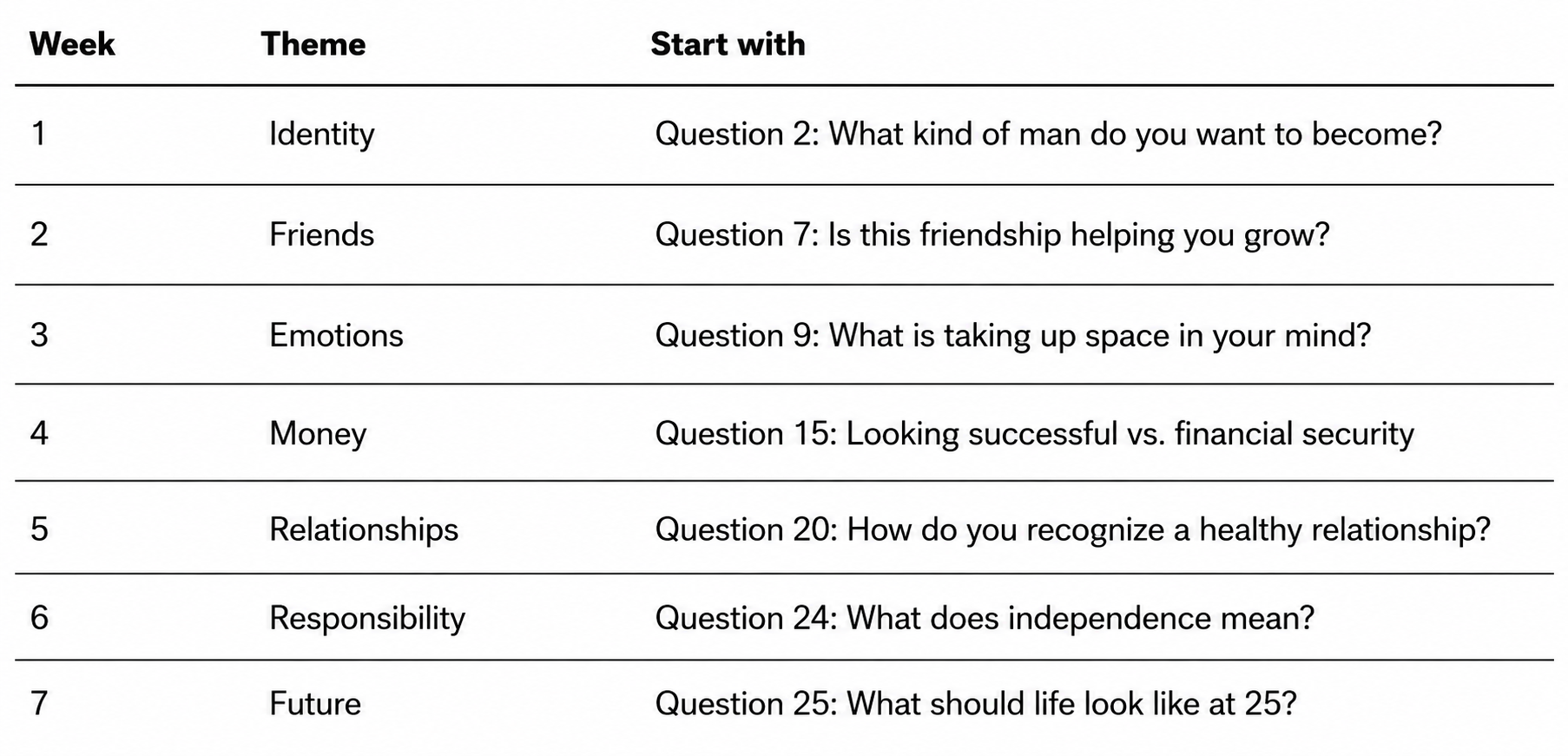
The goal is not to complete the chart. The goal is to build a relationship in which meaningful conversation becomes normal.
Frequently asked questions
What are the most important things a father should discuss with his son?
The most important subjects are identity, character, emotional health, friendships, peer pressure, money, work, relationships, consent, responsibility, failure and preparation for adulthood. The exact order should reflect the son’s age, maturity and present circumstances.
At what age should a father begin meaningful conversations with his son?
Begin with age-appropriate conversations as soon as a child can express thoughts and feelings. Do not wait for the teenage years to establish trust. The language and detail should grow as the child matures.
How often should fathers have serious conversations with their sons?
There is no required schedule, but brief and regular conversations are usually more natural than one enormous “talk.” Use everyday moments and return to major subjects repeatedly as your son grows.
What if my son gives only one-word answers?
Reduce pressure. Choose a shared activity, ask one specific open-ended question, allow silence and avoid reacting too quickly. If he is not ready, tell him the door remains open. For a complete strategy, read How to Talk to a Teenage Son Who Doesn’t Want to Talk once that companion article is published.
What if I did not have a father who talked with me?
You do not need to repeat what you received. Tell your son honestly that some of these conversations were missing from your childhood. Learn with him, admit what you do not know and seek reliable guidance when necessary.
Should a father share his past mistakes with his son?
Yes, when the story is age-appropriate and serves the son rather than relieving the father’s guilt. Explain the decision, consequence and lesson without glorifying harmful behavior or asking the child to carry adult emotional burdens.
What should I do if my son reveals something dangerous?
Stay calm, thank him for telling you and determine whether anyone is in immediate danger. Contact an appropriate qualified professional or emergency service. In the United States, call or text 988 for suicide or mental-health crisis support. Mandatory-reporting and emergency requirements vary by location.
Start with one question this week
Your son does not need a father who has a flawless answer for everything. He needs a father who is willing to be present, ask what matters, tell the truth and listen long enough to understand.
Choose one question from this list. Put the phone away. Give him your full attention. And when he answers, do not rush to prove that you are right.
That conversation may teach you something about your son that you could never learn by lecturing him.
For the larger framework behind these questions, read 7 Conversations Every Father Should Have With His Son Before He Turns 18.
Subscribe to the Build Better Dads YouTube channel for practical conversations about fatherhood, financial resilience, relationships and preparing children for the real world.
Help your son build resilience, responsibility and character with The UnBreakable Son Ebook.